Standard CAN frame format | Extended CAN frame structure
This page compares standard CAN frame format vs extended CAN frame format and mentions various fields used in standard CAN frame format and extended CAN frame structures.
Standard CAN Frame Format fields
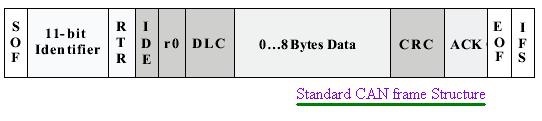
Figure-1 depicts standard CAN frame structure. Following table-1 describes fields used in standard CAN frame format. It uses 11 bit identifier.
| Fields | Description |
|---|---|
| SOF | Start of Frame bit. It marks start of message. It is used to synchronize nodes on the CAN bus. |
| Identifier | It is 11 bit (binary) in size. It establishes priority of message. Lower the value, higher is the priority. |
| RTR | It stands for Remote Transmission Request bit. This field is dominant when node requires information from another remote node. All the nodes receive request and all the nodes receive reply. Specific node processes the request based on identifier and transmits the reply. |
| IDE | Stands for Identifier Extension bit. It indicates standard CAN frame is being transmitted with no extension. |
| r0 | It is reserved for future use. |
| DLC | Stands for Data length code. It is 4 bits in size. It indicates number of bytes to be transmitted over the CAN bus. |
| Data | It contains upto 64 bits of application data. |
| CRC | It is used for error detection. It is 16 bits in size. It holds checksum for application data preceding to it. |
| ACK | It is 2 bits in size. It contains first bit as ack bit and second bit as delimiter. Each node uses this to show integrity of its data. Node receiving correct message overwrites this bit in original received message with dominate bit as mentioned above to indicate error free message has been transmitted. The node receiving erroneous message leaves this bit as recessive. Moreover it discards the message and hence prompts the sending node to re-transmit the message after re-arbitration process. |
| EOF | Stands for End of Frame. It is 7 bits in size. It marks end of CAN frame or message. |
| IFS | stands for Interframe space. It is 7 bits in size. It contains time required by controller to move correctly received frame to its proper position in message buffer area. |
Extended CAN Frame format fields

Figure-2 depicts extended CAN frame structure. Following table-2 describes fields used in extended CAN frame format. It uses 29 bit identifier.
| Fields | Description |
|---|---|
| SRR | It stands for Substitute Remote Request. This bit replaces RTR bit of standard CAN message location as placeholder in this extended CAN format. |
| IDE | It functions as recessive bit in identifier extension. It indicates that more identifier bits are followed. 18 bit extension follows IDE. |
| r1 | It is additional reserved bit for future use. |
Note: Illustrated Pictures and Tables are taken from Internet sources for better understanding.
REVIEW: The Mahindra XUV700 will cause havoc for everyone.
Domestic automaker Mahindra has reportedly removed several features starting from the entry-level MX variant to the top-spec AX7 L. The company has removed the rear parking sensors, height-adjustable driver seat, follow-me-home headlamps, and rear spoiler from the entry-level MX variants. The Mahindra XUV700 AX3 variants will no longer get a rear wiper and defogger, and selective unlock for the…

 Interesting Automotive Engineering
What is IFS
LikeLike
IFS stands for Interframe space. It’s 7 bit frame. I’ll update the every frame details in this blog. Thank you for asking questions. it’ll help me to improve the quality of this blog.
LikeLike